
Posts tagged service reliability
Een toekomstbestendig spoor? Geen miljarden smijten, wel slimme stappen zetten! (Column Mobiliteit.nl; jan 2026)
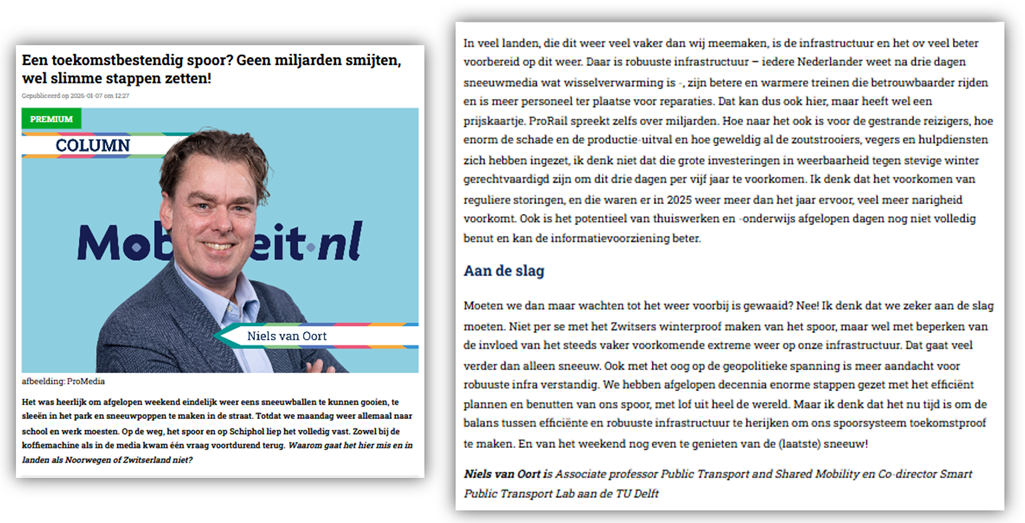
Meer achtergronden lees je HIER
Sneeuwoverlast op het spoor in verschillende media
Veel aandacht voor de sneeuwoverlast op het spoor in januari. Lees/luister meer via:
Moeten we ons land beter voorbereiden op sneeuw? ‘Hoge kosten wegen niet op tegen de baten, NPO Radio 1
Waarom er in Scandinavië wel treinen door de sneeuw rijden – en hier niet, RTL Nieuws
Datafouten en bevroren wissels ontregelen spoor tijdens winterweer, Volkskrant
In beeld: problemen op spoor en wegen door sneeuw, NRC
Uitgevallen treinen en geschrapte vluchten: waarom is Nederland niet ingericht op winterweer?, Volkskrant
Een toekomstbestendig spoor? Geen miljarden smijten, wel slimme stappen zetten! column Mobiliteit.nl
De H van Hoogwaardig OV
In de discussies over (de toekomst van) het ov in Nederland heeft de hoogwaardige bus, internationaal aangeduid als BHLS*, inmiddels een stevige plek verworven. Maar wat maakt een bus hoogwaardig, vroeg Youri Dekker zich af. En wat is de invloed van een specifieke huisstijl voor die hoogwaardigheid op de reiziger, maar ook op de logistiek? Samen met EBS en het Smart Public Transport Lab van de TU Delft deed hij onderzoek. “We moeten waken dat we niet alles hoogwaardig noemen en vervolgens niet de bijpassende kwaliteit leveren”.
Lees het hele artikel in OV magazine HIER
Lees het hele onderzoeksrapport HIER
* zie het boek Betere Bus
Podcast Mobility Innovators: Human-centered design for Smart Public Transport
Technology and New mobility are reshaping urban transportation in cities. Human-centric design is key to the quality of life in cities, putting people at the heart of urban transport planning. All stakeholders, including academia, will play a key role to reshape the future of mobility.
Listen to the podcast of Mobility Innovators with Niels van Oort:
04:00 Service reliability in public transport
07:40 About Smart Public Transport Lab at Delft University
14:00 How to run LRT system in the cities efficiently
20:20 Digital Inequality in Transport Services
28:50 Tesla predication on Self Driving Vehicles
34:50 MaaS from the passengers’ perspective
38:30 First & Last miles connectivity
44:54 Use of Big Data to improve services
49:05 Role of academia in the new world
Find more details about the discussed topics here:
Digital inequality (literature review paper)
Service reliability (podcast and papers)
5E model of wider impacts of public transport (book chapter 6, page 112-)
Amsterdam North/South metro line impact study
The four-year study conducted by TU Delft, AMS Institute and others into the transport-related, spatial and economic effects of the North/South metro line is now complete and was presented to Amsterdam’s regional and City councils end of 2021.
Find the final policy report here HERE
Find the main TU Delft research findings HERE
Find the interactive visualisations of the GVB timetable and anonymous passenger data before and after HERE
Find all research papers and reports HERE
MSc thesis Simon van Hees: Regional Travel Time and Transfer Impacts of the Noord/Zuidlijn using Interoperable Smart Card Data
Public Transport Reliability: podcast and book chapter
This podcast and book chapter discuss the elements of service reliability, the impact of service reliability on passengers, indicators that are used to measure reliability and variability, and how to make improvements. In this episode of the podcast Niels van Oort talks about the research behind the handbook chapter, including his PhD thesis and subsequent work. Some of the topics discussed are: the factors that can impact service reliability; the need for perspectives across strategic, tactical and operational levels; and bridging the gaps between front-line staff, management and researchers. Data sets, modelling and the practicality of optimal solutions are also discussed.
Learn more via http://publictransportresearchgroup.info/portfolio-item/rt35-niels-van-oort-public-transport-reliability/
Subjective Beliefs regarding Waiting Times in Public Transport Networks in the Netherlands, Greece, and Portugal
Waiting times in public transport networks (PTNs) are inherently uncertain for travellers and, similar to other service industries, such uncertainty is likely to be a major cause for anxiety and frustration (Maister, 1985). While real-time information regarding waiting times is an important development in mitigating such negative feelings, they do not completely remove uncertainty. Even when information is provided, travellers process it on the basis of their individual attitudes, habits, experiences, and contemporary contextual variables. Yet, previous studies on behavioural responses to travel time unreliability have either (unrealistically) assumed that travellers know the objective travel time distributions or have studied behaviour within the artificial context of travel simulators. Quantifying travellers’ attitudes and perceptions — subjective beliefs — regarding waiting times may be critical for assessment of travel satisfaction and subsequently choice behaviour.
In this research, a stated preference experiment is used to quantify travellers’ attitudes and perceptions — subjective beliefs — regarding waiting times in public transport networks in three European countries. Results and potential policy implications are presented at the European Transport Conference (ETC).
Find the ETC poster of Sanmay Shelat HERE
Impact assessment of new North/South metro line in Amsterdam
Large infrastructural projects are usually evaluated ex-ante before the decision to build the project is taken. However, after construction and opening of such project a thorough ex-post analysis is rare. In this paper we present an overview of such an evaluation study conducted in Amsterdam, capital of The Netherlands, including some first results. Research themes in the study are public transport, mobility and accessibility, public space and liveability and spatial economics. In this paper we focus on effects on public transport.
The new north-south metro line in Amsterdam became operational in summer 2018. This was accompanied by changes to the existing bus and tram network to provide feeder services to the new line, as well as to remove duplicate routes. Apart from adding significant capacity to the public transport network, the new line and the accompanying changes to the network are expected to improve travel times, reliability, accessibility and comfort levels (at least on average; not for all individual travellers).
The changes in such service quality attributes is expected to lead to a change in travel behaviour in terms of public transport route choice, mode choice (between public transport and private modes or within public transport), destination choice, departure time choice or addition of new trips (induced demand).
The objective of this study is to identify the main effects of the new metro line on existing and new passengers. We pay attention to the following aspects:
– Passenger volumes.
– Travel times, where the following distinction can be made:
o in-vehicle time;
o waiting time at the first stop;
o transfer walking time;
o transfer waiting time.
– Number of transfers.
– Network flows / crowding in vehicles.
– Reliability: travel time variance on the journey level.
– Accessibility: number of inhabitants and jobs reachable within a travel time budget.
Data sources for the study are GTFS timetable data (open source), Smart card data (both from within the city of Amsterdam as for the regional feeder bus services) and Automated Vehicle Location data. To measure perceived quality of the PT network, a survey is conducted among inhabitants of Amsterdam. In this survey approximately 3.800 respondents were asked about the travel time perceptions of their last PT trip, both before and after opening of the metro line. Finally, for a sample of travellers the entire trip is followed by a GPS tracking app.
Impact analysis of a new metro line in Amsterdam using automated data sources
A new metro line (the north-south line) was opened in Amsterdam in July 2018, adding significant capacity to the existing urban public transport network consisting of bus, tram and metro modes. The opening of the metro line was accompanied by changes to the existing bus and tram network, such as removal of duplicate routes and addition of feeder routes.
Traditionally, the impact of such a network change was measured either ex-ante or post-op based on surveys or model forecasts (Vuk 2005; Knowles 1996; Engebretsen, Christiansen, and Strand 2017). However, with the availability of automated data sources such as the smart card data, the exact impact on transit demand and service quality can now be measured. However, so far this has been limited to analysing the changes in travel times and reliability at a trip level (Fu and Gu 2018), excluding transfers.
This research utilises smart card and AVL data to study the impact of the new line on travel patterns (passenger flows), travel times and reliability from a passenger perspective by considering journeys including transfers. The metrics are calculated at a stop-cluster level, enabling also a distributional analysis of the impacts. Such a post-op analysis of any policy intervention or network change could be used to refine the demand predictive ex-ante tools.
Check the Transit Data workshop contributions of Malvika Dixit: Presentation and Extended abstract
Combining Speed Adjustment and Holding Control for Regularity based Transit Operations
Vehicle bunching often occurs in high-frequency transit systems leading to deterioration of service reliability. It is thus necessary to control vehicles during operations. Holding control is a common solution for this situation, but it may result in longer vehicle running times. Speed adjustments can contribute to more regular operations while preventing prolonged trip times. This paper proposes a control strategy, which combines these two strategies to maintain the regularity of transit operations. The findings based on simulation study for trunk bus services in the Netherlands suggest that combining the two strategies implies both the positive and negative attributes of each control.
Find the MT-ITS presentation and paper of Aishah Imram HERE and HERE