
Posts tagged Sociale inclusie
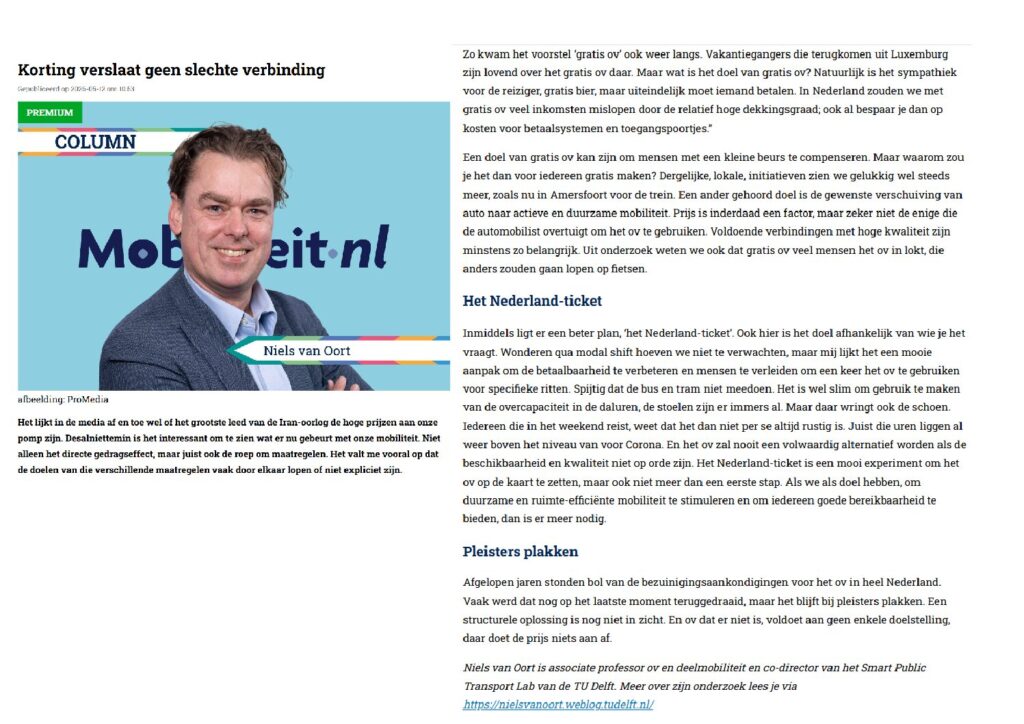
Smart Public Transport Lab onderzoek in OV Magazine
Sinds 2019 heeft OV Magazine een rubriek met onderzoeksresultaten uit het Smart Public Transport Lab (studenten en onderzoekers). Hieronder alle artikelen en onderwerpen. Bekijk ook de bundel met alle bijdragen t/m 2024, inclusief reflectie van o.a. studenten en Jan van Selm.
De hoogwaardige bus: Op papier of op straat? (2026)
Deelmobiliteit + ov = 3 (2025)
Wat vinden mensen met én zonder een beperking belangrijk voor toegankelijk ov? (2025)
Wat maakt een bus hoogwaardig? (2025)
Autoluwe wijken voor iedereen? (2025)
Goede bereikbaarheid voor ouderen: Dichtbij of nog ver weg? (2024)
Wat is de deelfiets-OV combinatie eigenlijk waard? (2024)
De route naar de hoogwaardige bus (2024)
Ook buiten de stad met OV-fiets combinatie (2024)
De deelautogebruiker bestaat niet (2023)
Een balans tussen meer en minder haltes (2023)
Verduurzaming regionaal spoor (2023)
Potentie voor Belgische nachttrein (2023)
Robuuste voorspellingen rijtijden (2023)
Covid impact op treingebruik (2022)
Gaan deelsteps Nederland veroveren? (2021)
Bus Rapid Transport (BRT) (2021)
Nieuwe vervoersmiddelen voor de last mile (2021)
Modal shift door HTM Fiets (2020)
Interesse werknemers in gebruik MaaS (2020)
Wil de reiziger bus of tram? (2020)
Verwachtingen gebruik nieuwe vervoersmiddelen van en naar het station (2019)
Druktebeleving in de tram (2019)
Betrouwbaar ov, maar toch buitengesloten
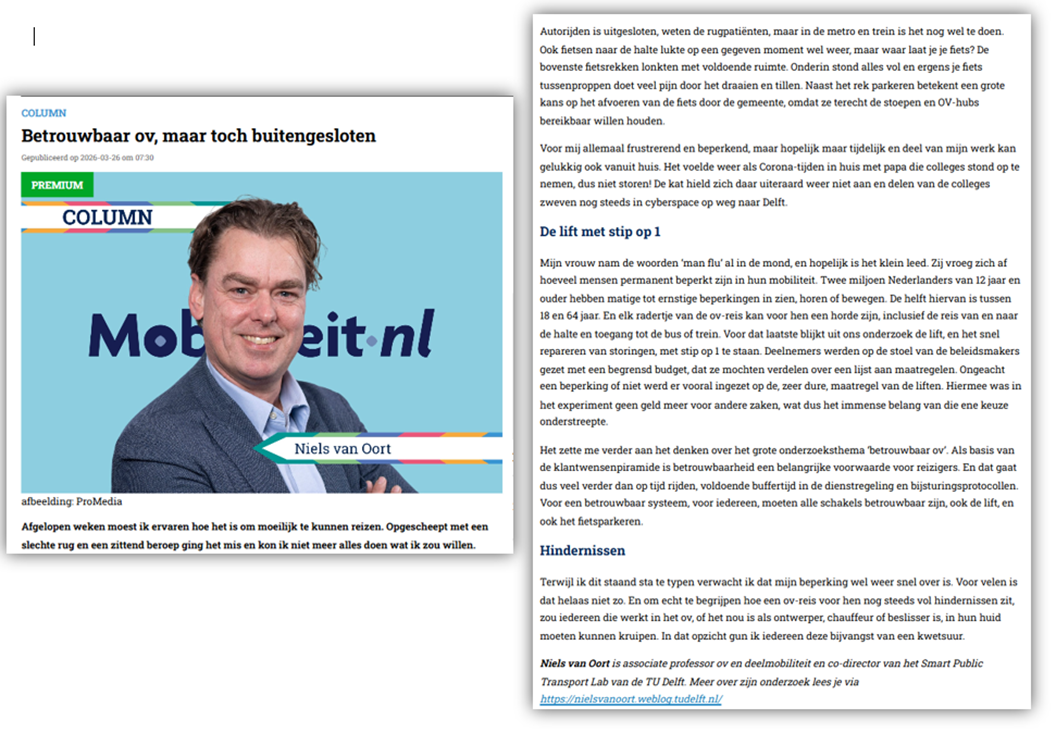
Lees de column via Mobiliteit.nl
Het onderzoek naar prioriteit van toegankelijkheidsmaatregelen zoals liften, lees je HIER.
Meer onderzoek over inclusieve mobiliteit vind je HIER.
The future of (public) transport
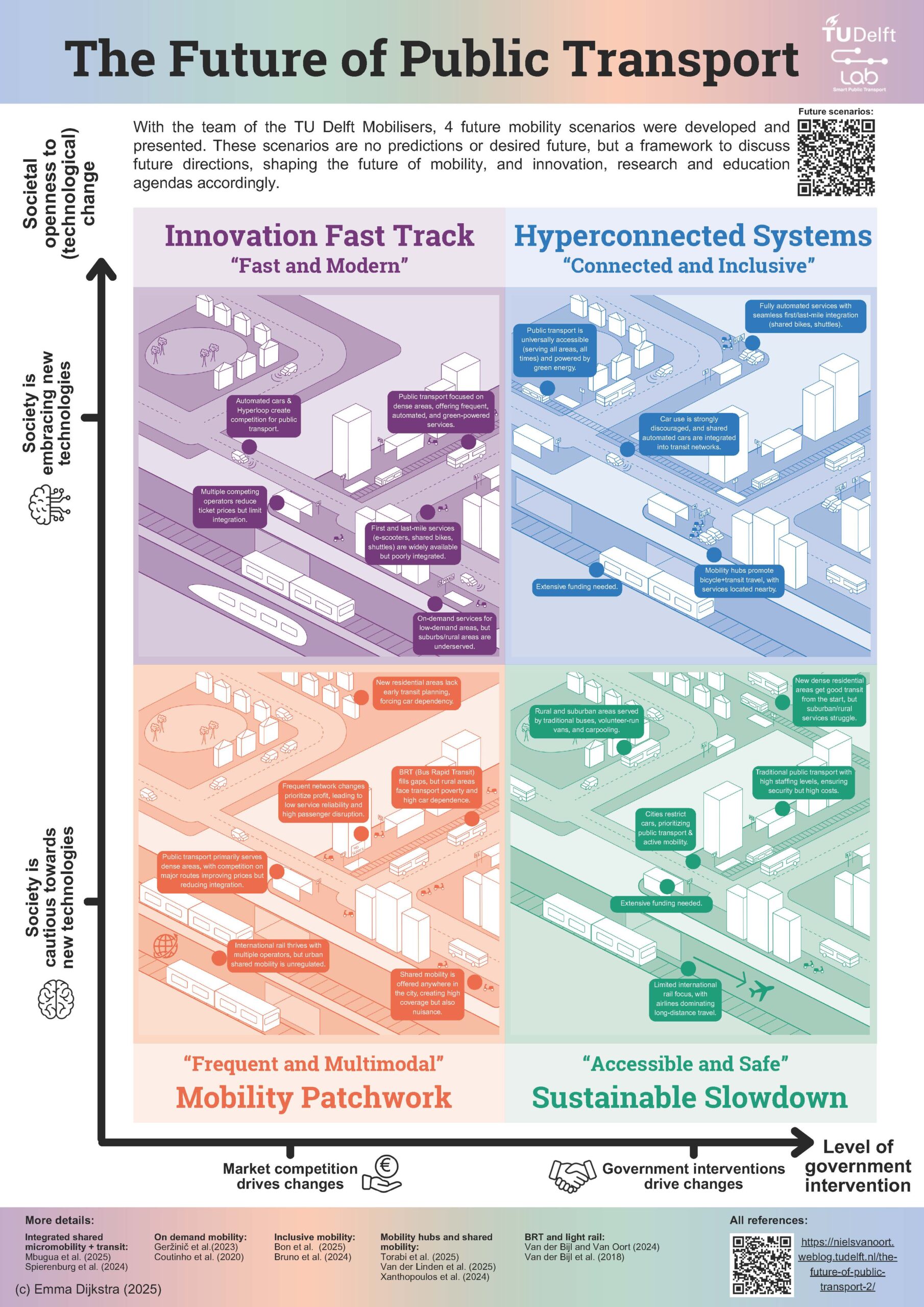
With the team of the TU Delft Mobilisers, we developed 4 future mobility scenarios. These scenarios are no predictions or desired future, but a framework to discuss future directions, shaping the future of mobility, and innovation, research and education agendas accordingly. Find the report HERE.
In addition to the general scenario description, the 12 Mobilisers, from 6 faculties, also wrote perspectives on their own domains. Read my perspectives on public transport and shared mobility HERE or in the infographic. Sources are accessible via the links below the figure.
Relevant research papers/books:
Integrated shared micromobility+transit
Mbugua, W., D. Duives, J.A. Annema, N. van Oort (2025), Societal costs and benefits analysis of integrating bike-sharing systems with public transport: A case study of the public transport bike (‘OV-fiets’) in the Netherlands, Case studies on transport policy.
Spierenburg, L., H. van Lint, N. van Oort (2024), Synergizing cycling and transit: Strategic placement of cycling infrastructure to enhance job accessibility, Journal of Transport Geography, Volume 116.
On demand mobility
Geržinič, N., O. Cats, N. van Oort, S. Hoogendoorn-Lanser & S.P Hoogendoorn (2023) What is the market potential for on-demand services as a train station access mode?, Transportmetrica A: Transport Science.
Coutinho, F.M., van Oort, N., Christoforou, Z., Alonso-González, M.J., Cats, O., Hoogendoorn, S.(2020), Impacts of replacing a fixed public transport line by a demand responsive transport system: Case study of a rural area in Amsterdam, Research in Transportation Economics, art. no. 100910.
Inclusive mobility
Bon, T., M. Bruno, N. van Oort (2025), Three-dimensional transport poverty and its socio-demographic and urban density predictors: Spatial regression analyses of neighborhoods in the Amsterdam metropolitan area, Transportation Research Interdisciplinary Perspectives, Volume 29.
Bruno, M., Kouwenberg, M., & van Oort, N. (2024). Evaluating How Transportation Policy Addresses Transport Related Social Exclusion: A Novel Method Applied to the Amsterdam Transport Region. Transportation Research Interdisciplinary Perspectives, Volume 26
Mobility hubs and shared mobility
Torabi, F., Y. Araghi, N. van Oort, S.P. Hoogendoorn (2025), A latent class approach to explore shared mobility among older people in Midsized Dutch inner cities, Transportation Research Interdisciplinary Perspectives, Volume 33.
Van der Linden, H., G. Correia, N. van Oort, S. Koster, M. Legêne, M. Kroesen (2025), Driving factors behind station-based car sharing adoption: Discovering distinct user profiles through a latent class cluster analysis, Transport Policy, Volume 162, P. 232-241.
Xanthopoulos, S., M. van der Tuin, S. Sharif Azadeh, G. Correia, N. van Oort, M. Snelder (2024), Optimization of the location and capacity of shared multimodal mobility hubs to maximize travel utility in urban areas, Transportation Research Part A: Policy and Practice, Volume 179.
BRT and light rail
Van der Bijl, R. and N. van Oort (2024), Betere Bus, Acquire Publishing
Van der Bijl, R., N. van Oort, B. Bukman (2018), Light Rail Transit Systems: 61 Lessons in Sustainable Urban Development, Elsevier.
Find more research (results) related to key concepts that play a role in (some of) these scenarios:
Inclusive mobility
Learn more about our research and findings regarding inclusive mobility:
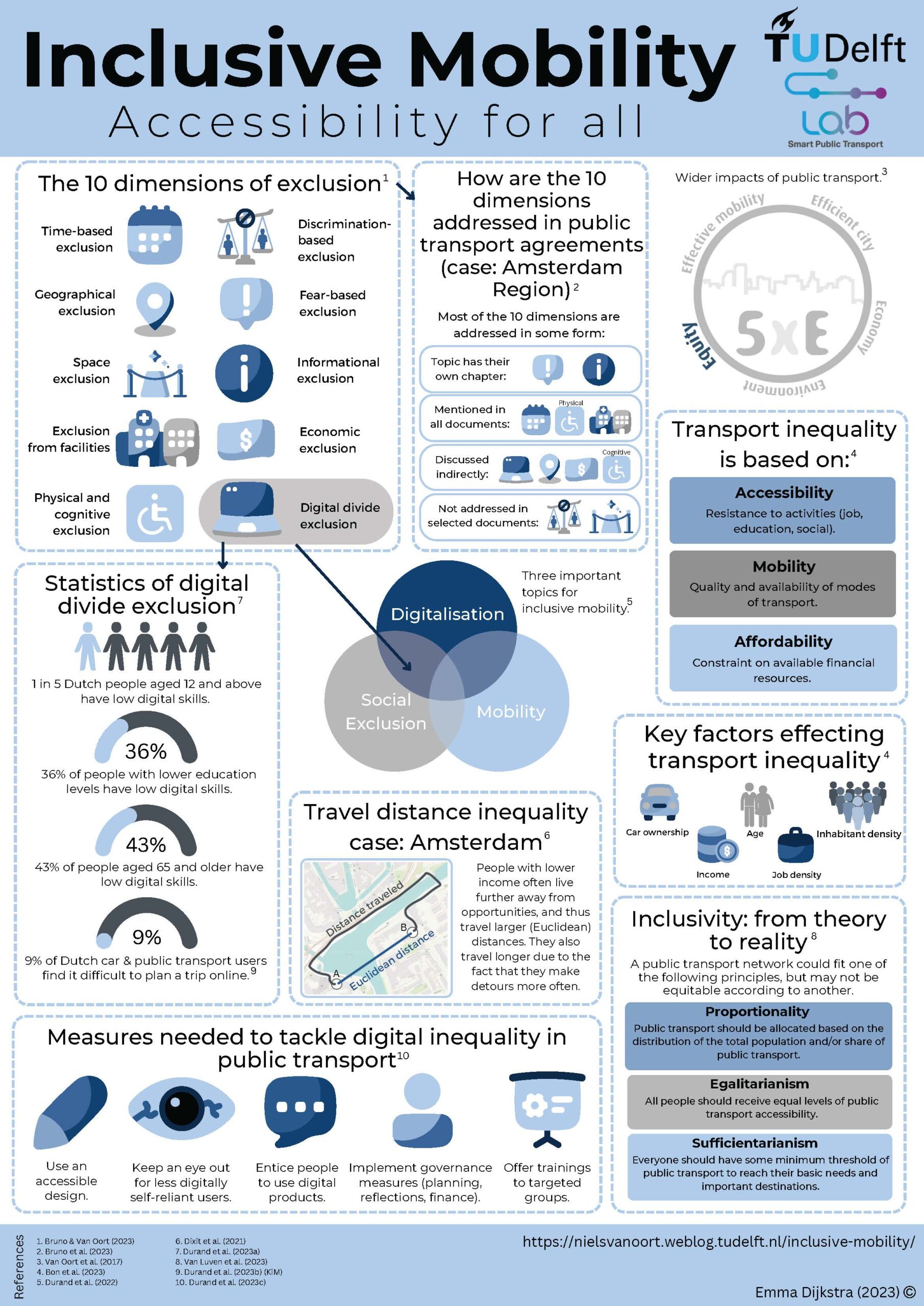
Download the infographic HERE
References
- Bruno, M., and N. Van Oort (2023) The ten dimensions of transport related social exclusion, position paper
- Bruno, M., Kouwenberg, M., & van Oort, N. (2024). Evaluating How Transportation Policy Addresses Transport Related Social Exclusion: A Novel Method Applied to the Amsterdam Transport Region. Transportation Research Interdisciplinary Perspectives, Volume 26.
- Van Oort, N., R.A.J. vd Bijl, F.C.A. Verhoof (2017), The wider benefits of high quality public transport for cities, European Transport Conference, Barcelona.
- Bon, T., Bruno, M., & van Oort, N. (2025). Three-dimensional transport poverty and its socio-demographic and urban density predictors: Spatial regression analyses of neighborhoods in the Amsterdam metropolitan area. Transportation Research Interdisciplinary Perspectives.
- Durand, A., Zijlstra, T., van Oort, N., Hoogendoorn-Lanser, S., & Hoogendoorn, S. (2022) Access denied? Digital inequality in transport services, Transport Reviews, 42:1, 32-57
- Dixit M., Chowdhury S., Cats O., Brands T., van Oort N. and Hoogendoorn S. (2021). Examining circuity of urban transit networks from an equity perspective, Journal of Transport Geography, Volume 91, 102980.
- Durand, A., Zijlstra, T., Hamersma, M., van Oort, N., Hoogendoorn-Lanser, S., & Hoogendoorn, S. (2023). “Who can I ask for help?”: Mechanisms behind digital inequality in public transport. Cities, 137, 104335
- Van Luven, M., N. van Oort, O. Cats, M. Bruno, M. Kouwenberg (2023), How to achieve an equitable distribution of accessibility by evaluating and modifying public transport networks: a comparison of accessibility distribution principles in the Netherlands, European Transport Conference, Milano.
- Durand, A., Hamersma, M., Rienstra, S. (2023). Use and perceived effects of digital travel information for car and public transport travel. Brochure. The Hague: Netherlands Institute for Transport Policy Analysis (KiM).
- Durand, A., Zijlstra, T., Hamersma, M., van Oort, N., Hoogendoorn-Lanser, S., & Hoogendoorn, S. (2023). Fostering an inclusive public transport system in the digital era: an interdisciplinary approach. Transportation Research Interdisciplinary Perspectives, Volume 22, 100968.
Toegankelijk OV
Voor veel mensen met een beperking is het openbaar vervoer de enige manier om (zelfstandig) te reizen. Vorig jaar concludeerde de Verenigde Naties echter dat Nederland te weinig doet om de toegankelijkheid van het openbaar vervoer voor deze groep te waarborgen. Reden voor TU Delft student Jelmer Nederhof om hier onderzoek naar te doen. “Ik wilde vooral onderzoeken wat mensen zelf verbeterd willen zien.”
Lees het artikel “Wat vinden mensen met én zonder een beperking belangrijk voor toegankelijk ov?” in OV magazine
Download het hele onderzoeksrapport (Engels) HIER
Een Nederlandse samenvatting van het onderzoek vind je HIER
Equity in (public) transport
On Tuesday May 13th, Anne Durand successfully defended her PhD thesis “Lost in Digitalisation? Navigating public transport in the digital era” at Delft University of Technology. On the occasion of this public defence, TRAIL and the Transport and Mobility Institute of TU Delft organised a seminar on Transport Equity. See all output below:
“Overview equity in Transport (Research)” by Prof. dr. Bert van Wee (TU Delft)
“The Role of Digital Integration and Digital Skills in the Uptake of Shared Mobility” by Prof. dr. ing. Karst Geurs (University of Twente)
“Rethinking Electric Mobility Transitions: A Global South and Social Justice Perspective” by Dr. Frauke Behrendt (Technical University Eindhoven)
Find the PhD thesis of dr. Durand HERE
Find more on equity in public transport HERE
Onderzoeksagenda / Research agenda
In het openbaar vervoer is nog maar weinig bij het oude. Ontwikkelingen als elektrificatie, automatisering en deelmobiliteit hebben hun impact op vraag én
aanbod. Behalve vlot en veilig moet het ov ook groen en inclusief zijn. En dan is er de nog altijd voelbare impact van covid-19. Om op dit speelveld de juiste keuzes te maken, heeft het ov nieuwe inzichten en nieuwe tools nodig. Zie hiervoor mijn (geactualiseerde) Onderzoeksagenda.
The world of public transport is changing rapidly. Developments such as electrification, automation, and shared mobility have had an impact on both demand and supply. Besides being smooth and safe, public transport must now also be green and inclusive. And then there is the still tangible impact of Covid‑19. To make the right choices in this evolving landscape, we need new knowledge and new tools. Find my (updated) Research Agenda.
Gratis ov?
De plannen om de trein in de spits veel duurder te maken, riep o.a. de tegenreactie op voor gratis ov.
OneWorld schreef dit stuk over deze vraagstukken, inclusief kleine bijdrage van mij. Hieronder deel ik nog enkele extra punten.
Gratis ov klinkt sympathiek, maar leidde tot nog toe nergens tot (de vaak verwachte) grote verschuiving van auto naar ov. Er worden wel veel extra kilometers gemaakt, vaak ten koste van fietsen en lopen, en de kosten zijn vaak hoog. Die benodigde investering kan dan niet voor verbeteringen v.w.b. ov infrastructuur of exploitatie worden gebruikt.
Effectievere maatregelen voor een inclusiever en duurzamer mobiliteitssysteem bestaan zowel aan de ov als auto-zijde: meer snelle, comfortabele, betrouwbare verbindingen enerzijds en bijv. kilometerheffing anderzijds.
Betaalbaarheid is essentieel voor een inclusief mobiliteitssysteem, maar betaalbaar is niet hetzelfde als gratis voor iedereen. Gratis OV kan wel zinnig zijn, maar dan voor specifieke groepen en locaties, zoals we al zien voor bijvoorbeeld studenten of bepaalde groepen in Nederlandse steden. Soms is het makkelijk maken van reizen, geen gedoe voor kiezen en kopen van een kaartje, een goed argument voor gratis ov.
Het idee voor veel duurdere treinkaartjes in de spits is vanuit economisch perspectief te begrijpen (het beprijzen van schaarste), maar minder als we ov ook vanuit een maatschappelijke perspectief, zoals duurzaamheid of inclusiviteit, bekijken. Niet iedereen heeft invloed op zijn of haar reismoment of kan thuiswerken. Als de ov spits duurder wordt en de autospits niet, is er ook een verschuiving naar de auto te verwachten.
Kortom, liever goed en betaalbaar ov dan gratis ov!