
Posts in category English
Podcasts
Luister naar verschillende podcasts over OV en deelmobiliteit: /Listen to multiple podcasts about transit and shared mobility:
Race naar 0; stadsinrichting en mobiliteit, Ayden
Toekomst van het openbaar vervoer, Den Haag FM
Optimal Mix: Light Rail vs. Bus Rapid Transit, Transit Unplugged (ENGLISH)
The bicycle and transit combination, Dutch Cycling Embassy (ENGLISH)
Designing optimal Public Transport and shared modes, Mobility Innovators (ENGLISH)
Service reliability in public transport, Monash University Researching transit (ENGLISH)
Podcast The mobility transition – a connecting problem, Mayor’s Manual: Episode #6, AMS Institute (ENGLISH)
Podcast Bike+Transit, BikeTalk (ENGLISH)
De bus moet sexy worden, BNR radio
Iedereen mobiel: Vanzelfsprekend! (Video)
De toekomst van het OV, Radio 1
De toekomst van duurzame mobiliteit, ProRail
What is the value of integrating bike sharing systems and public transport?
From abroad, people often look enviously at the success of the Dutch integration of cycling and public transport, where the best of both worlds come together. Not only for the first miles to the station, but also for the final part of the journey, thanks to the availability of shared bikes. Watetu Mbugua, who came from Kenya to study in Delft, was surprised at how relatively little people knew about this success. That’s why she conducted research in the Smart Public Transport Lab into the societal costs and benefits of this combination, using the “OV-fiets” (public transport bike operated by the Dutch Railways (NS)) as a case study.
By: Niels van Oort (Article translated from Dutch, see OV Magazine)
“The research started with an extensive search in international literature on all the aspects that contribute to the (societal) costs and benefits,” says the Kenyan. “Based on the 14 most important factors, I then looked for data to quantify the effects of OV-fiets for the past 20 years and monetize them. It was a painstaking task, but I’m proud that I succeeded.”
Mirjam Borsboom from the cycling policy team of the Ministry of Infrastructure and Water Management confirms the international interest. “On average, the Netherlands receives more than four (!) requests per day from around the world, asking about cycling. Especially about cycling infrastructure, culture, and incentive projects. In large cities, the bike+public transport combination is particularly popular, leading to many questions, for example, about bike parking at public transport stations.”
Mbugua found that the benefits regarding accessibility were especially large, followed by congestion reduction and health benefits. On average, the benefits were 50% higher than the costs, such as investment and operational expenses. To avoid overly optimistic results, she worked with ranges and sensitivity analyses. “In every scenario, we actually see that the benefits outweigh the costs, even when very conservative assumptions are applied, such as the shift from car to bike+public transport.” In some cases, the benefits were as much as 2.5 times higher than the costs, making it a clearly socially responsible investment. “In the Netherlands, cycling is already very common, so the potential in other countries could be even greater,” Mbugua expects.
That is also where Borsboom sees the main value of this study: “Not only to further apply and improve the Dutch bike+public transport system but also to assist other countries in setting up similar systems.” As far as Mbugua is concerned, the Netherlands should be more proud of its existing bicycle+public transport system. She sees room for improvement particularly in high-quality bus and light rail connections, where shared bikes play only a minor role. “The potential to apply this success abroad is huge, but attention to road safety is crucial. Unfortunately, in many parts of the world, cycling often comes with high risks due to a lack of safe infrastructure,” she concludes.
The full research can be read at https://repository.tudelft.nl/record/uuid:70ca79cc-d6de-47c3-a707-88068d233008
Mobility hubs: Why, who, how?
Mobility hubs are often presented as the solution for enhanced accessibility, a shift towards sustainable mobility and/or improved public space. Sometimes, they seem to be a goal in itself.
In our research, we try to find out how to achieve the mobility, spatial and societal goals by investigating the potential users and their needs, and the required offered modes and facilities accordingly.
The highlights of multiple research projects are presented the infographic below. More details and extra insights are available via the related research papers.

References
- Hoogenboom (2024), Exploiting the benefits of a mobility hub to incentivize shared car usage.
- Montes, A., N. Geržinic, W.V. Veeneman, N. van Oort, S.P. Hoogendoorn (2023), Shared micromobility and public transport integration – A mode choice study using stated preference data, Research in Transportation Economics, Vol. 99, 101302.
- Spierenburg, L., H. van Lint, N. van Oort (2024), Synergizing cycling and transit: Strategic placement of cycling infrastructure to enhance job accessibility,
Journal of Transport Geography, Volume 116. - Van der Meer, T. Leferink, N. Geržinič, J. A. Annema and N. v. Oort (2023), Identifying potential use of emerging neighbourhood mobility hubs using behavioural modelling, 8th International Conference on Models and Technologies for Intelligent Transportation Systems (MT-ITS), Nice, pp. 1-6.
- Van Gerrevink, I., J. de Jong, N. van Oort (2021), Ex-post evaluatie van mobiliteitshubs: Een kwalitatieve studie naar de factoren die het gebruik en de effecten van mobiliteitshubs beïnvloeden. CVS congres Utrecht. (in Dutch; English report)
- Van Kuijk, R.J., G. Homem de Almeida Correia, N. van Oort, B. van Arem (2023), Preferences for first and last mile shared mobility between stops and activity locations: A case study of local public transport users in Utrecht, the Netherlands, Transportation Research Part A: Policy and Practice, Volume 166.
- Vianen, J., N. van Oort, M. Walvius (2022) Een wijkhub voor iedereen? Inzichten in de behoefte aan hubfaciliteiten en deelmobiliteit voor verschillende bevolkingsgroepen. CVS congres Utrecht (in Dutch; English report)
- Xanthopoulos, S., M. van der Tuin, S. Sharif Azadeh, G. Correia, N. van Oort, M. Snelder (2024), Optimization of the location and capacity of shared multimodal mobility hubs to maximize travel utility in urban areas, Transportation Research Part A: Policy and Practice, Volume 179.
Onderzoeksagenda / Research agenda
In het openbaar vervoer is nog maar weinig bij het oude. Ontwikkelingen als elektrificatie, automatisering en deelmobiliteit hebben hun impact op vraag én
aanbod. Behalve vlot en veilig moet het ov ook groen en inclusief zijn. En dan is er de nog altijd voelbare impact van covid-19. Om op dit speelveld de juiste keuzes te maken, heeft het ov nieuwe inzichten en nieuwe tools nodig. Zie hiervoor mijn (geactualiseerde) Onderzoeksagenda.
The world of public transport is changing rapidly. Developments such as electrification, automation, and shared mobility have had an impact on both demand and supply. Besides being smooth and safe, public transport must now also be green and inclusive. And then there is the still tangible impact of Covid‑19. To make the right choices in this evolving landscape, we need new knowledge and new tools. Find my (updated) Research Agenda.
MT-ITS conference: Identifying potential use of emerging neighbourhood mobility hubs using behavioural modelling
Neighbourhood mobility hubs may play an important role in mitigating the impact of passenger cars on climate change and urban public space. As a relatively new concept, academic research on the user potential of neighbourhood mobility hubs is so far limited. This research aims to identify which user groups are likely to adopt services offered by a neighbourhood mobility hub. A survey was distributed in the Netherlands (N=298) and an Exploratory Factor Analysis (EFA) and a Latent Class Cluster Analysis (LCCA) were executed. Four distinctive groups of intended users were uncovered. Two of the clusters have intentions to use neighbourhood mobility hubs. The other two identified clusters do not (yet) intend to use neighbourhood mobility hubs. The clusters indicate that people who currently already travel more by sustainable modes (train or (e-)bicycle) are more likely to be adopters of neighbourhood mobility hubs than the traditional car users. In practice, this may make the positive effect of hubs more limited than anticipated or even increase car use. However it could also facilitate those travelling sustainable to do so for longer as additional shared modes become available to them via hubs. Limitations and directions for further research are discussed.
Read the paper of Van der Meer et al. (2023) HERE
Find the presentation of MT-ITS (2023) in Nice HERE
The full research report is available HERE
More insights into mobility hubs and shared mobility:
10 dimensions of transport related social exclusion
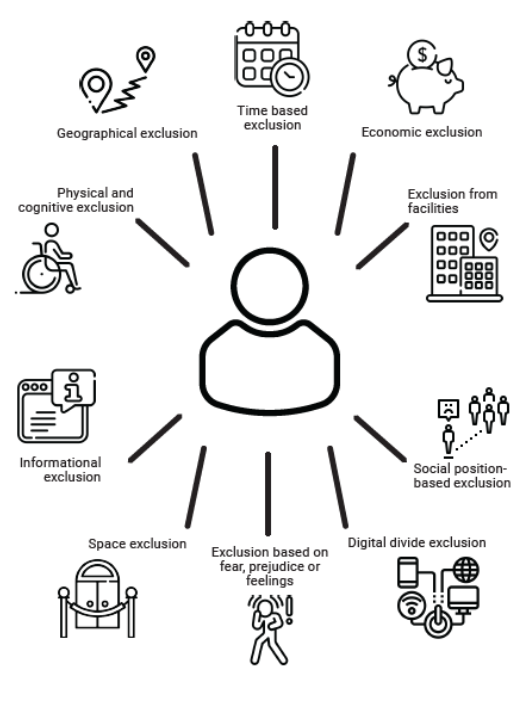
Transport Related Social Exclusion (TRSE) looks at how people who are socially disadvantaged for reasons such as employment status, income, age, or ability, can face limitations in their ability to access transportation services. As income is only one of these factors, people can experience TRSE without having a low income (Yigitcanlar et al., 2018). Rather, social exclusion is defined by an exclusion from economic life, social services, civic life, and social networks (Spoor, 2013). TRSE looks at how elements of the transportation system contribute to this exclusion (Yigitcanlar et al., 2018).
This figure provides an overview of 10 dimensions of Transport Related Social Exclusion, further explained (incl. references) in the position paper of Bruno and Van Oort (2023).
PhD project: Robust train trajectory optimization
In cooperation with the Dutch Railways (NS), Alex Cunillera works in this PhD research on robust train trajectory optimization. Even two trains of the same model running on the same line show significant differences in their dynamics. This might be due to different passenger loads, weather, fault history, driving style of the train driver, etc. Moreover, there are uncertainties in the track data that may also have a strong influence on the train operation. This research focuses on determining the uncertainties and stochastics of these variations and developing methods to compute robust train trajectories that optimize the energy consumption and minimize delays in the presence of the mentioned variations.
Project contributions (ongoing):
Papers:
Train motion model calibration: research agenda and practical recommendations (ITSC 2022)
Presentations:
Real-time train motion parameter estimation using an Unscented Kalman Filter (RailBeijing 2021)
Train motion model calibration: research agenda and practical recommendations (ITSC 2022)
Inclusief openbaar vervoer, van theorie naar praktijk
Hoewel de theorieën over rechtvaardige mobiliteit niet nieuw zijn, missen we nog wel kennis over de implicaties en toepassing. Monica van Luven van het Smart Public Transport Lab deed bij de Vervoerregio Amsterdam onderzoek. “We staan nog aan het begin van goede inbedding van inclusieve mobiliteit in onze beleidscyclus en moeten nog verschillende belangrijke keuzes maken.”
Lees HIER het hele onderzoek
Het 3-jarige onderzoek van TU Delft en Vervoerregio over inclusieve mobiliteit vind je HIER
Ons onderzoek naar de digitale kloof i.s.m. het Kennisinstituut voor Mobiliteitsbeleid vind je HIER
Covid impacts on train travel behaviour
Delft University of Technology and the Dutch railways (NS) started a joint, longitudinal research in April 2020 on Covid impacts on train passenger behaviour. During the pandemic, 7 surveys in different stages (15,000-45,000 participants each) were held to learn about the impacts and expectations. The main results are presented in an infographic.
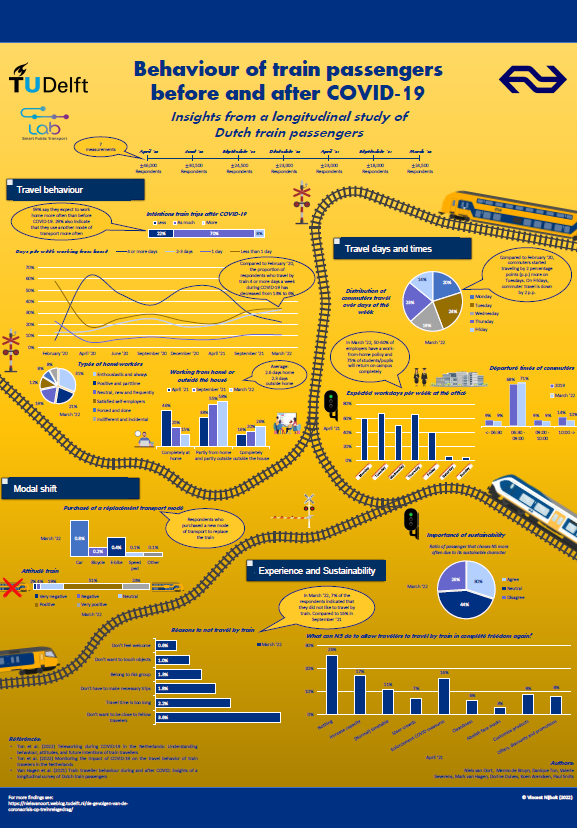
Find the high resolution infographic HERE. Also available in DUTCH
Find the detailed results in these scientific papers:
Transportion research-Part A: Teleworking during COVID-19 in the Netherlands: Understanding behaviour, attitudes, and future intentions of train travellers
Bivec Transport Days: Train traveller behaviour during and after Covid: insights of a
longitudinal survey of Dutch train passengers
Transport Research Procedia: Monitoring the impact of COVID-19 on the travel behavior of train
travelers in the Netherlands
Find other output such as reports, presentations and media articles
Micromobility and public transport
Following technological and societal developments, new modes and services arrive in our cities. Micromobility solutions, such as shared (e-)bikes and –scooters, are adding new opportunities for individuals, but what their (potential) contribution is to societal objectives such as sustainability, land use and inclusiveness, is not yet known. In order to gain this knowledge and optimize the mobility mix, the Smart Public Transport Lab investigates the demand and supply impacts and interaction of micromobility, including the interaction with public transport. In this infographic the main, recent results of the ongoing research are summarized.

Find more results and details in the related papers and theses:
1. Ma et al. (2020): Bike-sharing systems’ impact on modal shift: A case study in Delft, the Netherlands
2. Van Marsbergen et al. (2022): Exploring the role of bicycle sharing programs in relation to urban transit
3. Alberts (2021): Standing e-scooters, what to expect: micro-mobility with micro effects?
4. Van Kuijk et al. (2022): Preferences for shared modes of local public transport users in the last mile
5. Limburg (2021): Potential for sustainable mode usage amongst car users in mid-sized cities
6. Montes et al. (2023): Studying mode choice in multimodal networks including shared modes
7. Stam et al. (2021): Travellers’ preferences towards existing and emerging means of first/last mile transport: a case study for the Almere centrum railway station in the Netherlands
8. Geržinič et al. (2022): Potential of on-demand services for urban travel
9. Torabi et al. (2022): Passengers preferences for using emerging modes as first/last mile transport to and from a multimodal hub case study Delft Campus railway station